Interstate Dreams: How America Went From Slow Roads to Speed in a Single Generation
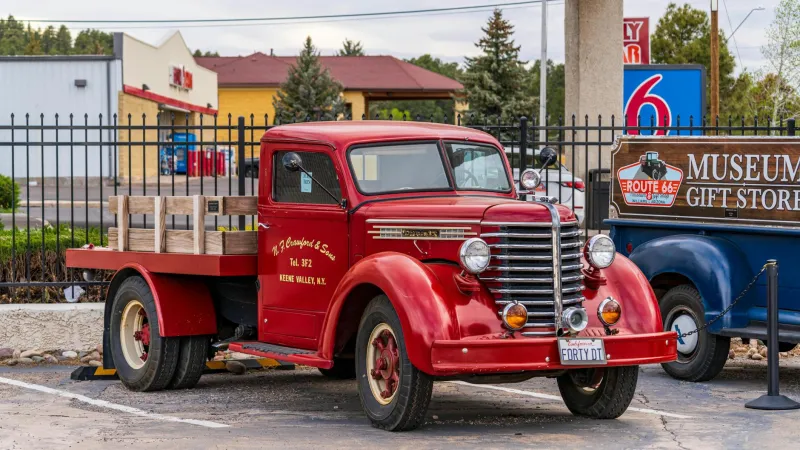
Interstate Dreams: How America Went From Slow Roads to Speed in a Single Generation
Imagine planning a family road trip from Chicago to Los Angeles in 1945. You'd pack your sedan, kiss your neighbors goodbye, and budget nearly two weeks for the journey. Your route would snake through dozens of small towns, each with its own speed limits and traffic patterns. You'd stop at motor courts—small family-owned motels scattered along the highways—and eat at diners that served the same meatloaf to travelers from a dozen different states. The journey wasn't just long. It was the entire vacation.
Fast forward to 1960, just four years after President Eisenhower signed the Federal Aid Highway Act. That same Chicago-to-Los Angeles drive? Now doable in 36 hours of continuous driving, or a comfortable three-day trip with overnight stops. The difference wasn't just time saved. It was a complete reimagining of what American mobility could be.
When Roads Were a Patchwork Quilt
Before the Interstate System, America's highway network was a fragmented mess. Each state maintained its own roads with its own standards, speeds, and priorities. Driving from one state to another meant adjusting to different road widths, different signage systems, different safety standards. A road that was perfectly smooth in Ohio might turn to gravel in Indiana. What was a 55-mile-per-hour zone in one state became a 35-mile-per-hour crawl through the next.
The 1930s and 1940s saw America's roads clogged with an explosion of personal vehicles—Americans had fallen in love with the freedom of the open road—but the roads themselves hadn't evolved to handle the volume. A cross-country journey required serious planning. You'd consult Rand McNally maps, mark your route with a pencil, and hope you didn't hit unexpected construction. Gas stations were sparse outside major towns. Hotels were unpredictable. The entire experience was an adventure in the truest sense: you couldn't always predict what you'd find around the next bend.
The Act That Changed Everything
On June 29, 1956, Eisenhower signed legislation that would reshape the American landscape more profoundly than almost any other government project of the 20th century. The Federal Aid Highway Act authorized $114 billion (in today's dollars) to construct 41,000 miles of high-speed, limited-access interstate highways. The goals were practical: improve national defense by enabling rapid military mobilization, reduce traffic fatalities through better road design, and improve commerce by slashing shipping times.
What actually happened was a quiet revolution.
The Interstate System didn't just connect cities. It rewrote the geography of American opportunity. Suddenly, a factory owner in Detroit could feasibly move operations to a cheaper location in the South and still maintain supply chains. A salesman could cover twice as much territory in the same week. Families could drive six hours for a weekend visit to relatives instead of planning a week-long expedition. The very concept of "distance" started to shrink.
The Numbers That Tell the Real Story
Let's be specific about what changed:
New York to Los Angeles: 1940 (via US Route 66 and state roads): 5-6 days of driving, often stretched to a week with stops and delays. 1970 (via Interstate 40 and Interstate 15): 2.5-3 days of driving.
Chicago to Miami: 1945: 4-5 days minimum. 1975: 24-30 hours.
San Francisco to Seattle: 1950: 18-20 hours of driving time, but realistically a three-day journey. 1980: 12-13 hours, doable in a single overnight push.
But the speed improvement was only part of it. Interstates eliminated the unpredictability. You knew exactly what you'd get: smooth pavement, consistent speed limits (initially 70 mph), predictable rest stops, and standardized signage. The anxiety of the journey—Will I find a place to sleep? Will my car break down in the middle of nowhere?—largely evaporated.
The Unexpected Casualties
Here's what's rarely discussed: the Interstate System killed an entire ecosystem of American small-town commerce. Those motor courts that once dotted Route 66? Most closed. The diners that served travelers? Many shuttered. Small towns that had thrived as necessary stops on cross-country journeys suddenly became irrelevant. You could now drive past them at 70 miles per hour without slowing down.
The system also enabled sprawl in ways that small towns couldn't have imagined. Why live in the city when you could live in the suburbs and commute? The Interstate made that possible. It fundamentally altered where Americans chose to live, work, and build their lives.
What We Gained (and Lost)
By the 1980s, the transformation was complete. American road culture had entirely shifted. Family vacations were no longer about the journey itself—they were about reaching a destination. You didn't stop to explore small towns or chat with locals at motor courts. You grabbed a quick meal at a standardized rest stop (or later, a chain restaurant off an exit), refueled, and kept moving.
The Interstate System did exactly what it was designed to do: it made America smaller and more connected. It reduced travel times so dramatically that long-distance commuting became feasible. It enabled economic integration that wouldn't have been possible on the old road network. It made the country feel less vast and more unified.
But in doing so, it also homogenized American travel culture. The romance of the open road—the unpredictability, the encounters with strangers, the sense that you were genuinely exploring—gave way to efficiency. You could now get from one coast to the other in less time than it once took to get from Chicago to Kansas City.
The Lasting Legacy
Today, we barely think about the Interstate System. It's so woven into the fabric of American life that we forget it's only 70 years old. The idea that you could drive across the country in a weekend feels natural, inevitable. But to someone from 1945, it would have seemed like magic.
The Interstate didn't just change how fast we move. It changed what we consider possible, what distances feel manageable, and where we're willing to live. It collapsed time and space in ways that still ripple through American culture. When you factor in modern vehicles, GPS, and 24-hour gas stations, the transformation is even more dramatic.
Your grandfather planned a cross-country road trip the way you might plan a month-long international vacation. You can do it on a whim. That shift—from monumental undertaking to weekend getaway—represents one of the most profound transformations in how Americans experience their own country.