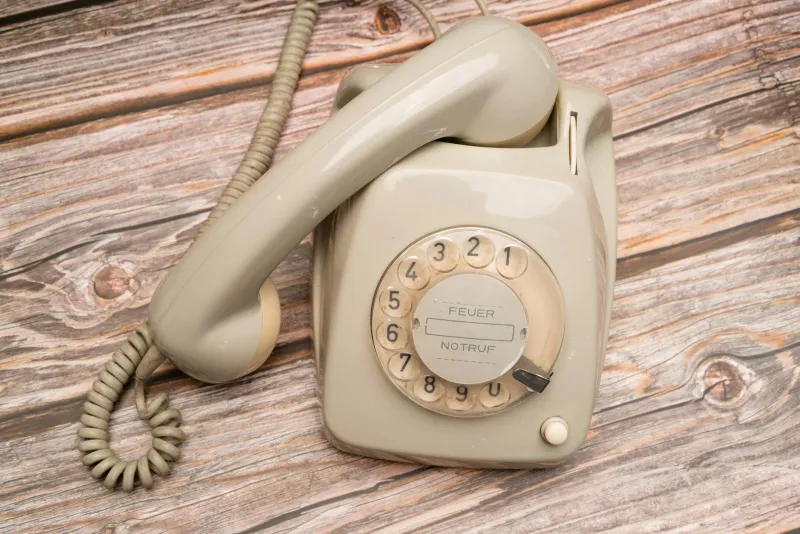
Hanging on the Hendersons' kitchen wall in 1978 was a harvest gold rotary phone with a 20-foot curly cord. It was the family's sole connection to the outside world, and everyone—from Dad's work calls to teenage Lisa's marathon conversations with friends—had to share it.
The phone rang for everyone. Privacy meant stretching that cord as far as it would go, usually into the hallway or around the corner into the dining room. Important calls got interrupted by dinner prep. Teenagers learned the art of negotiation, trading phone time for chores or promising to keep conversations short.
Today, that same family would carry five different phones, each with private numbers, personal contacts, and 24/7 availability. The shared communication hub has vanished, taking with it a particular kind of family dynamic that shaped how Americans talked, listened, and related to each other.
The Democracy of the Dial Tone
The single household phone created an unintentional system of communication equality. Everyone had the same access—and the same limitations. You couldn't make a call while someone else was talking. You couldn't receive a private message without others potentially overhearing. The phone belonged to the household, not the individual.
This forced a kind of social coordination that seems almost quaint today. Families developed informal schedules: Mom's sister called every Tuesday at 7 PM. Dad handled business calls before dinner. Teenagers got phone privileges after homework was finished.
"We all knew each other's friends by voice," remembers Carol Nakamura, who raised three children in the 1980s. "I could recognize Jenny's voice calling for my daughter, or tell when my son's friend Mike was nervous about asking something. You became familiar with your family's entire social circle."
When Privacy Required Planning
The shared phone created a peculiar relationship with privacy. Truly confidential conversations required strategy. Some families installed phone jacks in bedrooms, but even then, other family members could pick up an extension and listen in.
Teenagers developed elaborate systems for private communication. They'd call friends from pay phones at school, write letters, or wait until parents were out of the house. The effort required to have a private conversation made those interactions feel more significant.
"If you really needed to tell someone something personal, you found a way," says David Park, who was a teenager in suburban Chicago during the 1970s. "But most of our conversations happened in front of family, and that wasn't necessarily a bad thing. It kept us connected."
The Art of Household Negotiation
Sharing one phone line taught negotiation skills that today's children never develop. Siblings had to work out fair usage agreements. Parents mediated disputes over who got to make calls when. Everyone learned to keep track of time and respect others' needs.
The phone also created natural conversation limits. You couldn't monopolize the line indefinitely because others were waiting. This forced people to be more concise, more purposeful in their communications.
"My daughter would give me a five-minute warning when she needed the phone," recalls James Wright, a father of two in 1980s Atlanta. "She learned to wrap up conversations gracefully, to plan what she wanted to say. There was a courtesy to it all."
The Disappearing Middleman
Perhaps most significantly, the household phone made family members intermediaries for each other's social lives. Parents answered calls for their children and vice versa. This created countless small interactions that built familiarity and connection.
"Mrs. Johnson, is Kevin home?" became a standard greeting that connected neighbors and built community relationships. Parents learned about their children's friendships through these daily interactions. Children developed phone manners by speaking to adults regularly.
Today's direct-dial culture has eliminated these intermediary conversations. Children text friends directly without ever speaking to their parents. Adult relationships bypass spousal filtering. The social connective tissue that the shared phone created has quietly dissolved.
The Economics of Connection
The single phone line also imposed economic discipline on communication. Long-distance calls were expensive and carefully rationed. Families planned important calls for evenings and weekends when rates dropped. International calls were rare events requiring advance planning and time limits.
This scarcity made communication more intentional. People wrote letters for non-urgent matters. They saved up topics for scheduled phone calls. The cost of connection meant that maintaining relationships required genuine effort and planning.
"We'd get the phone bill and analyze every long-distance call," says Ruth Martinez, who managed a household budget in the 1970s. "A 20-minute call to my mother in California was a significant expense. It made those conversations precious."
What We Gained and Lost
The shift to personal mobile devices has brought undeniable benefits. Families can coordinate schedules more easily. Emergency communication has improved dramatically. Children have access to educational resources and social connections that transcend geographical boundaries.
But something subtler was lost in the transition. The shared phone created forced interaction points throughout the day. Family members had to acknowledge each other's social lives. The household's communication rhythm was visible and negotiated collectively.
"Now everyone disappears into their own device," observes Dr. Sherry Turkle, who studies technology's impact on families at MIT. "We've gained efficiency and privacy, but we've lost the daily practice of considering others' communication needs."
The Unintended Consequences
Modern families often struggle with issues that the shared phone automatically prevented. Children develop phone anxiety because they never practiced talking to adults. Parents lose track of their children's social circles because communication bypasses family oversight. The art of polite interruption—essential for shared phone use—has atrophied.
Meanwhile, the constant availability of personal devices has eliminated the natural conversation boundaries that scarcity once provided. Without the forced time limits of a shared line, digital conversations can stretch indefinitely, consuming time once available for other family interactions.
Lessons From the Party Line
Some families are rediscovering benefits of shared communication practices. They designate phone-free dinner hours or create family charging stations where devices rest during evening time together. These intentional practices attempt to recreate some of the natural interaction patterns that the shared phone once provided.
The harvest gold rotary phone hanging in the Henderson kitchen wasn't just a communication device—it was a family coordination system, a negotiation trainer, and a community connector. Its limitations created skills, relationships, and rhythms that the smartphone's capabilities have made obsolete.
Whether that trade-off was worth it remains an open question, but understanding what we exchanged might help us be more intentional about what we choose to preserve.