The Plastic Rectangle That Changed Everything
Sarah Chen still remembers the weight of possibility in her pocket. At age seven, she carried her first library card like a talisman — a small plastic rectangle that represented unlimited access to everything humans had ever written, discovered, or imagined. The Riverside Public Library wasn't just a building filled with books; it was a portal to infinite worlds that existed nowhere else in her small Ohio town.
 Photo: Sarah Chen, via cdn.tatlerasia.com
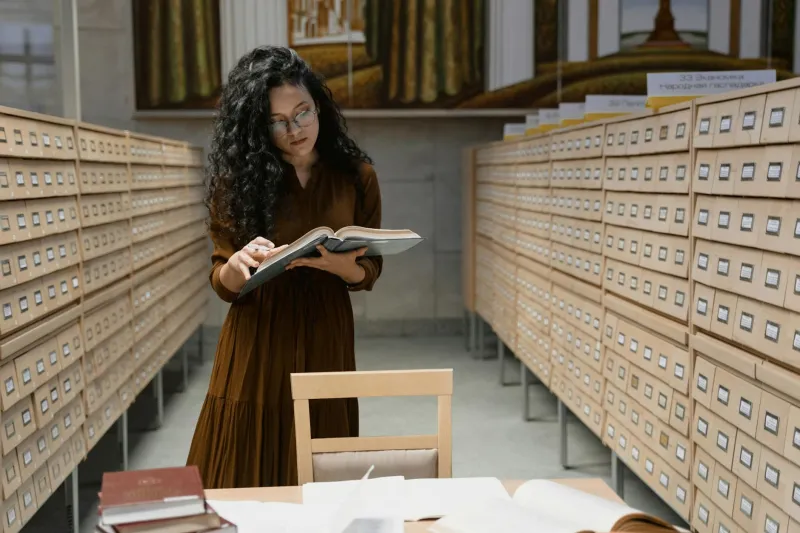
 Photo: Riverside Public Library, via static.wixstatic.com
On Saturday mornings, Sarah would ride her bike to the library with a specific mission: find answers to questions that had been burning in her mind all week. Why do cats purr? How do airplanes stay in the sky? What did ancient Egypt really look like? Each question required a journey through card catalogs, reference sections, and careful note-taking that made every discovery feel earned.
Today, Sarah's seven-year-old daughter carries a smartphone that can answer any question in seconds. Yet somehow, the questions have stopped coming.
When Knowledge Had Geography
The pre-internet library represented something that's nearly impossible to recreate today: scarcity that created value. Information wasn't infinite — it was curated, organized, and finite. The Riverside Library's 40,000 books represented the carefully selected best of human knowledge, chosen by librarians who understood both their community's needs and the broader landscape of worthy ideas.
This scarcity created a different relationship with information. When you couldn't Google "ancient Egypt" and get 2.3 million results in 0.47 seconds, you learned to work with what was available. You read entire books rather than skimming article summaries. You took notes by hand, which forced you to process and synthesize information rather than simply bookmark it for later.
The physical act of research required patience, planning, and commitment. You couldn't instantly jump from topic to topic with hyperlinked abandon. Instead, you developed deep focus and followed sustained lines of inquiry that led to genuine understanding rather than surface-level awareness.
The Librarian as Information Architect
Mrs. Patterson, Riverside Library's head librarian for thirty-two years, served as something between a teacher, detective, and information architect. She didn't just check out books — she guided research, recommended reading paths, and helped patrons develop information literacy skills that would serve them throughout their lives.
 Photo: Mrs. Patterson, via www.hampden-library.org
When Sarah wanted to understand photosynthesis for a school project, Mrs. Patterson didn't hand her a single book. Instead, she created a research pathway: start with the children's science encyclopedia for basic concepts, move to the high school biology textbook for more detail, then examine National Geographic articles for real-world applications. Each source built on the previous one, creating a structured learning experience that developed both knowledge and research skills.
This guidance was crucial because information wasn't self-organizing. The library's classification system — those mysterious Dewey Decimal numbers — created logical connections between related topics. Browsing the 500s section (pure sciences) naturally led to discoveries in mathematics, physics, chemistry, and biology. The physical arrangement of knowledge encouraged serendipitous learning that simply doesn't happen when search algorithms predict exactly what you're looking for.
The Ritual of Deep Reading
Library culture promoted sustained attention in ways that feel almost foreign today. Reading rooms enforced silence, encouraging the kind of focused concentration necessary for deep comprehension. Without notifications, alerts, or hyperlinks, readers developed the ability to follow complex arguments through dozens of pages without distraction.
The checkout system itself encouraged commitment to ideas. When you could only borrow a limited number of books for a limited time, you chose carefully and read thoroughly. The artificial scarcity created by checkout limits forced prioritization and prevented the information hoarding that characterizes modern digital consumption.
Sarah remembers spending entire afternoons working through a single encyclopedia volume, following cross-references and related topics in a way that built comprehensive understanding rather than fragmented knowledge. The physical weight of books, the texture of pages, and the linear progression of information all contributed to a reading experience that engaged multiple senses and promoted retention.
The Paradox of Infinite Access
Today's information landscape would seem miraculous to library patrons of the 1980s. Every book ever written, every scientific study ever published, every news article ever printed — all available instantly from anywhere in the world. The barriers that once limited access to information have essentially disappeared.
Yet studies consistently show declining reading comprehension, shorter attention spans, and reduced information retention among both children and adults. The same generation that has unprecedented access to information struggles with basic research skills that were once taught as a matter of course in library settings.
The paradox isn't that information became more available — it's that availability without scarcity fundamentally changed how we value and process knowledge. When everything is accessible, nothing feels precious. When answers come instantly, we stop developing the patience necessary for complex understanding.
The Death of Browsing
Perhaps the greatest loss in the transition from library to internet research is the disappearance of productive browsing. Libraries were designed for discovery — you might enter looking for information about the Civil War and leave with books about Abraham Lincoln's psychology, 19th-century medicine, and the economics of slavery.
This wasn't inefficiency; it was how knowledge actually develops. Real understanding comes from seeing connections between seemingly unrelated topics, and the physical organization of libraries encouraged exactly this kind of cross-pollination.
Modern search algorithms, despite their sophistication, tend to narrow rather than broaden inquiry. They predict what you want and deliver it efficiently, eliminating the happy accidents and unexpected discoveries that characterized library research. The result is more targeted information but less comprehensive understanding.
The Social Architecture of Learning
Libraries also served as community learning centers in ways that purely digital information cannot replicate. The reference desk created opportunities for intergenerational knowledge transfer. Older patrons shared research strategies with younger ones. Study groups formed organically around shared tables and common interests.
The library's physical space enforced a kind of democratic access to information — the professor and the elementary student used the same card catalog, followed the same research procedures, and had access to the same resources. This shared experience created common information literacy skills across educational and economic lines.
What We Gained and Lost
The benefits of digital information access are undeniable. Research that once took weeks can now be completed in hours. Rare books and documents are available to anyone with an internet connection. Real-time information allows for immediate fact-checking and current awareness that libraries could never provide.
But the costs are becoming clearer as we observe the first generation to grow up entirely in the digital information age. Attention spans have shortened. Research skills have atrophied. The ability to sustain focus through complex arguments has diminished. Most troublingly, the sense that knowledge is valuable and worth pursuing for its own sake has been replaced by a utilitarian approach that treats information as a commodity to be consumed rather than wisdom to be developed.
The Librarian's Last Lesson
Mrs. Patterson retired in 2019, just as the COVID-19 pandemic forced libraries to close their physical doors and move services online. In her farewell letter to the community, she wrote something that captures what was lost in the transition to digital information:
"A library card was never just about borrowing books. It was about joining a community of learners, developing the patience to seek real answers to complex questions, and discovering that the most important questions are the ones that lead to other questions. I worry that we've made information so easy to find that we've forgotten why it was worth looking for in the first place."
Today, Sarah's daughter can ask Siri any question and receive an instant answer. But she rarely asks questions anymore — and when she does, she rarely remembers the answers. The plastic rectangle in her pocket contains infinitely more information than Sarah's childhood library card ever provided access to. Yet somehow, it feels infinitely less powerful.
The library card represented not just access to information, but initiation into a way of thinking about knowledge that treated it as precious, connected, and worthy of sustained attention. We gained the ability to know anything instantly. We may have lost the wisdom to know what's worth knowing at all.