When Flying Was an Event: The Vanished World of the Golden Age Airline Passenger
When Flying Was an Event: The Vanished World of the Golden Age Airline Passenger
Picture yourself at JFK in 1965. You're wearing your good coat. There's no security line, no scanner, no bin for your shoes. A uniformed attendant greets you by name at the gate. Within the hour, you'll be eating beef tenderloin off real china at 30,000 feet, with a linen napkin across your lap and a cocktail you didn't pay extra for.
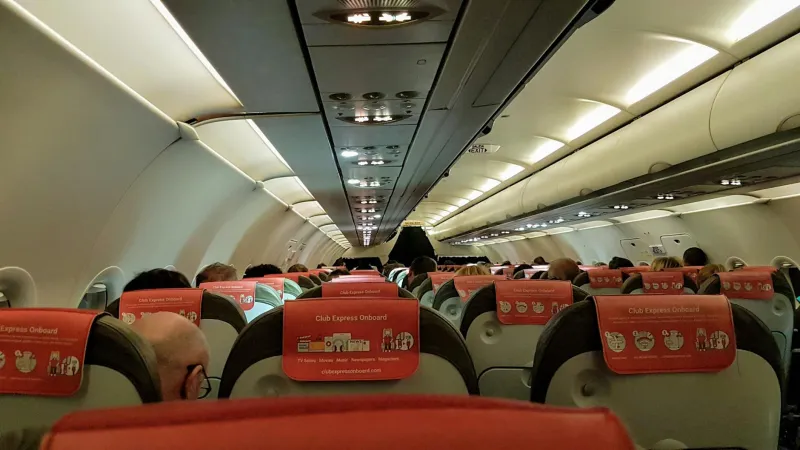
Now picture today's version of that same trip. A middle seat on a Tuesday. A $14 sandwich in a plastic wrapper. Seventeen minutes of legroom. And a boarding process that somehow takes longer than the actual flight.
Something changed. Not just the experience — the entire idea of what flying was.
The Ticket That Cost a Fortune — But Felt Like It
Here's the number that catches most people off guard: flying in the 1960s was genuinely, significantly more expensive than it is today. A round-trip coach ticket from New York to Los Angeles in 1965 ran about $220. Adjusted for inflation, that's somewhere north of $2,000 in today's money. First class? You could double that easily.
For context, the median American household income in 1965 was around $6,900 a year. A cross-country round trip in coach represented roughly three weeks of average earnings. Flying wasn't casual. It wasn't something you did to visit your college roommate or catch a long weekend in Vegas. It was a major financial decision, and it came loaded with social weight.
That weight showed. Airlines competed on experience because they legally couldn't compete on price. The Civil Aeronautics Board regulated fares so tightly that carriers had no choice but to out-luxury each other. Pan Am. TWA. Eastern. Braniff. The names alone carried prestige. These weren't transportation companies — they were lifestyle brands before anyone used that phrase.
What the Ticket Actually Bought You
The differences in the physical experience are almost hard to believe if you've only ever known modern commercial aviation.
Legroom in standard coach cabins averaged around 35 inches of seat pitch in the 1960s. Today, budget carriers routinely offer 28. That gap doesn't sound like much until you're six feet tall and three hours into a flight.
Meals in coach — actual meals, not snack boxes — were standard on flights of any meaningful length. Full service: appetizer, entrée, dessert, coffee. The food wasn't always spectacular, but it was real, it was included, and it arrived on a tray that didn't require a degree in origami to balance on a folding table.
First class in that era occupied a different dimension entirely. Lie-flat seats existed on some transatlantic routes as early as the late 1950s. Cocktail lounges were built into certain widebody aircraft. Passengers on long-haul Pan Am flights were sometimes handed menus — actual printed menus — and asked to select their entrée. The whole thing felt less like transportation and more like a restaurant that happened to be airborne.
And the staff-to-passenger ratio? Flight attendants in the 1960s were managing cabins a fraction of the size of today's planes, with stricter service protocols and considerably more time per passenger to actually provide that service.
1978 and the Deal That Changed Everything
The Airline Deregulation Act of 1978 is arguably the single most consequential piece of legislation in the history of American travel. Before it passed, the federal government controlled where airlines could fly and what they could charge. After it passed, those decisions belonged to the market.
What followed was a rapid, sometimes brutal transformation. New carriers entered the space. Fares dropped. Routes expanded to smaller cities that had never seen commercial service. The hub-and-spoke model emerged. Mergers followed. Airlines that had built their entire identity around luxury found themselves competing against bare-bones operators who could undercut them on every route.
By the mid-1980s, the math had fundamentally shifted. A domestic round trip that once cost the equivalent of two weeks' wages could now be had for a fraction of that. Flying stopped being an occasion and started being a mode of transit — more like a bus with wings than a rolling dinner party.
What We Gained, What We Gave Up
It would be easy to frame this as a simple story of decline — glamour traded for cattle-car economics. But that's not quite right, and it's worth being honest about what the trade actually bought.
Deregulation made flying accessible to people who had genuinely never considered it a realistic option. By 1990, Americans were taking roughly twice as many flights per year as they had in 1978. By 2000, the number had nearly doubled again. Working-class families started flying home for holidays. College students started studying abroad. The world got meaningfully smaller for a much larger group of people.
At the same time, the experience shed almost everything that had made it feel special. The dress code vanished. The meals vanished. The legroom contracted. The staff-to-passenger ratio stretched. Airlines began monetizing every inch of the journey — checked bags, seat selection, early boarding — turning what had once been bundled luxury into an à la carte list of fees.
The Timelapse View
When you zoom out and look at the full arc, what you're really seeing is a classic accessibility trade-off. The golden age of flying was genuinely golden — but only for a sliver of the population who could afford it. The modern version is genuinely worse in almost every qualitative sense, but it belongs to everyone.
Whether that trade was worth it depends on where you sit — figuratively, and quite literally. For the business traveler who flew constantly either way, deregulation mostly just removed the perks. For the family in rural Ohio who flew for the first time in 1987 because the price finally made sense, it opened up the entire world.
The next time you're wedged into a middle seat somewhere over Kansas, that context won't make the seat any wider. But it might make the whole thing feel a little less like a loss.