When Six O'Clock Meant Everyone Knew the Same Thing — Before the News Became Personal
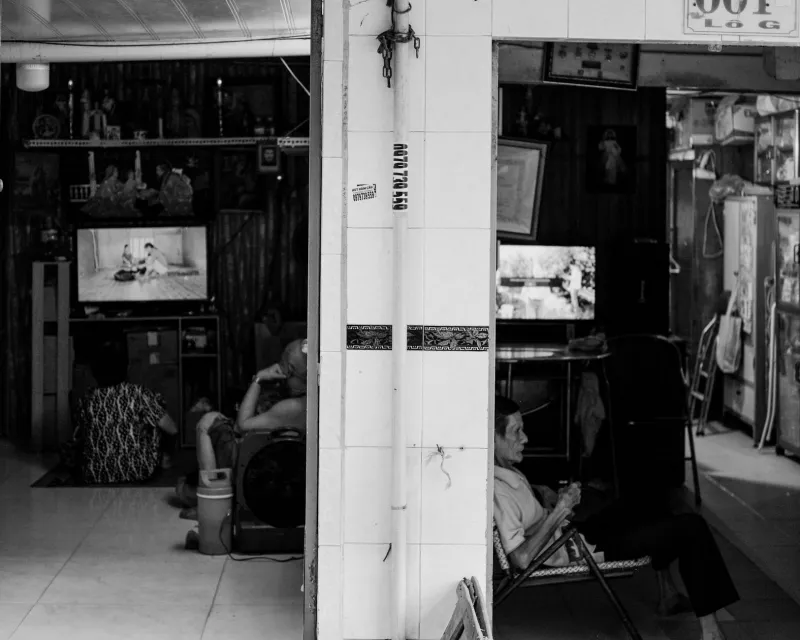
On July 20, 1969, an estimated 600 million people around the world watched Neil Armstrong step onto the lunar surface. In the United States, most of them were watching the same three networks. The same anchors. The same footage. The same moment.
You could argue about what it meant. You could not argue about whether it happened.
That shared factual baseline — that common pool of verified information that most Americans drank from daily — is one of the things the last thirty years quietly dismantled. And the full cost of losing it is still being calculated.
The Three-Network Universe
For roughly four decades, from the rise of television news in the late 1950s through the early 1990s, American information consumption was remarkably unified. Not identical — newspapers competed fiercely, local TV markets had their own personalities, and magazines like Time and Newsweek offered different editorial lenses. But the architecture of the information ecosystem funneled most Americans through a relatively small number of shared sources.
CBS, NBC, and ABC evening newscasts together drew somewhere between 50 and 75 million viewers on a typical night in the 1970s. In a country of about 220 million people, that's a staggering concentration of shared attention. Walter Cronkite was once polled as the most trusted person in America — not the most trusted journalist, the most trusted person. That's a sentence that's almost impossible to imagine applying to anyone in media today.
The gatekeeping was real, and it had genuine problems. Stories got buried. Perspectives got excluded. The voices that made it onto the evening news reflected the biases — racial, class-based, geographic — of the institutions that controlled the microphone. That's not a small criticism. It's a legitimate one.
But gatekeeping also meant verification. It meant that before a story reached millions of people, someone with professional accountability had checked it. Not perfectly. Not always fairly. But someone.
The Cable Crack, Then the Internet Fracture
CNN launched in 1980 and introduced the concept of 24-hour news. That was the first crack in the shared-reality model. If news was always on, it needed to be constantly refreshed, debated, and dramatized. The news cycle that had once turned daily began turning hourly, then by the minute.
Fox News and MSNBC arrived in 1996 and completed a different kind of transformation. News was no longer just delivered — it was delivered with an explicit ideological flavor. Audiences could now choose not just when to get their news but which version of reality they preferred. Ratings data quickly confirmed that people, given the choice, tend to select information that confirms what they already believe.
Then came the internet. Then social media. Then the algorithm.
By the early 2010s, Facebook had become the primary news source for a significant portion of American adults. And Facebook's algorithm wasn't designed to inform — it was designed to engage. Engagement, it turned out, was driven less by accuracy than by outrage, novelty, and emotional intensity. The platform that billions of people used to understand the world was optimizing for clicks, not comprehension.
The Statistics Are Uncomfortable
A 2021 Pew Research study found that only 26% of Americans trusted the news media "a lot" or "some." That number was above 70% in the 1970s. The Edelman Trust Barometer, which tracks institutional confidence globally, has consistently ranked the United States near the bottom of developed nations in media trust for the past several years.
Meanwhile, the fragmentation of information consumption has accelerated. Americans now get news from dozens of sources — podcasts, YouTube channels, Substack newsletters, TikTok videos, X (formerly Twitter) threads — many of which operate with no editorial standards, no correction policies, and no accountability structures of any kind.
The result isn't just that people disagree about what policies are best. It's that they increasingly disagree about what facts are true. That's a different kind of problem, and a much harder one to solve.
What the Shared Era Actually Felt Like
It's worth being honest about what the old model provided that we've lost. There was something genuinely powerful about a society operating from a common factual foundation. Political disagreements were sharper and more productive when both sides acknowledged the same underlying reality. Civic life — school board meetings, local elections, community debates — assumed a shared set of facts that made argument possible rather than pointless.
There was also something quietly democratic about the experience of watching the same broadcast as your neighbor, your coworker, and your grandmother. It was imperfect and often exclusionary. But it created a kind of connective tissue that's now largely gone.
Today, two people can spend eight hours consuming news and finish the day with not a single overlapping fact in common. That's not an exaggeration. That's a documented feature of the current media environment.
Is There a Way Forward?
Some media researchers argue for renewed investment in local journalism, which has been gutted over the past two decades as advertising revenue migrated to digital platforms. Local news, historically, has been less ideologically sorted than national media — people tend to care less about the partisan angle of a story about a school budget or a road closure.
Others point to media literacy education as a long-term solution. Teaching people to evaluate sources, identify manipulation, and distinguish between opinion and reporting is genuinely valuable. But it's a slow process, and the platforms are moving faster.
What's clear is that the information environment we've built isn't producing a more informed citizenry. It's producing a more opinionated one — which is not the same thing.
Cronkite used to close every broadcast with the same four words: And that's the way it is. The phrase sounds almost quaint now. Because increasingly, the way it is depends entirely on where you're looking.