A Quarter, a Tray, and a Hot Meal: How School Lunch Became America's Most Contested Table
The Bell Rings, the Line Forms
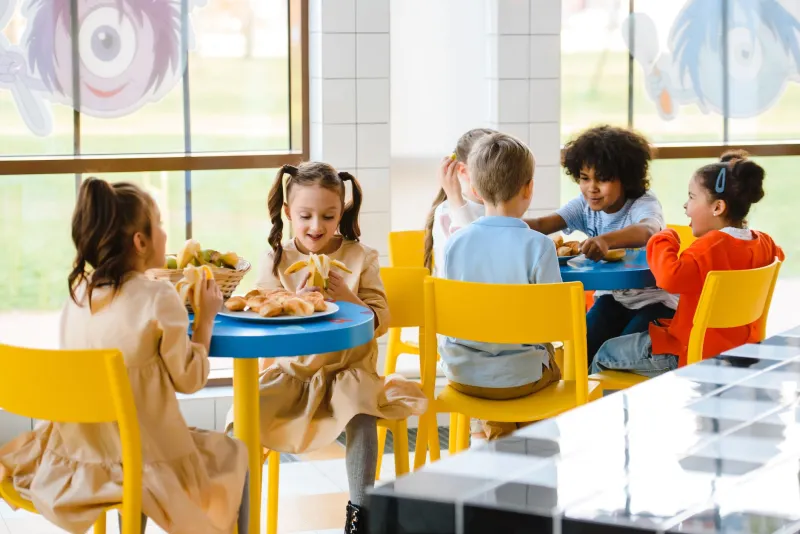
In any American elementary school during the 1960s, lunch worked like this: the bell rang, kids filed into the cafeteria, grabbed a tray, and got a hot meal. Maybe it was chicken and mashed potatoes. Maybe it was tomato soup with a buttered roll. Whatever it was, it cost somewhere around twenty-five cents, the government had helped pay for most of it, and by noon every kid in the building had eaten.
There was no lunch debt. There was no alternate meal policy. Nobody got a cold cheese sandwich because their account balance had run low. The cafeteria was just part of school — as ordinary and assumed as the water fountain or the gymnasium.
That version of school lunch feels almost quaint now. Because somewhere between that postwar cafeteria line and the present day, a simple daily meal became one of the most contested rituals in American public life.
How the National School Lunch Program Started
The roots of the federal school lunch program go back further than most people realize. Congress passed the National School Lunch Act in 1946, partly motivated by military concerns — during World War II, draft boards had been alarmed by the number of young men rejected for service due to malnutrition. A hungry country couldn't field a strong army, the thinking went, so feeding kids in school was a matter of national security as much as anything else.
 Photo: World War II, via img.freepik.com
The program was designed to be practical and broad. The federal government subsidized meals, particularly for lower-income students, and gave schools access to surplus agricultural commodities. The result was a system that, for all its institutional blandness, actually worked. By the late 1960s, roughly 20 million children were eating federally supported lunches every school day.
The food wasn't gourmet. But it was hot, it was real, and it was there.
When the Cracks Started Showing
The system began to fray in ways that are still playing out today. Budget pressures in the 1970s and 1980s pushed school districts to find cheaper ways to run cafeterias, which opened the door to food service contractors and processed food suppliers who could hit lower price points. The famous 1981 episode — when the Reagan administration briefly proposed classifying ketchup as a vegetable to meet nutritional guidelines — became a cultural punchline, but it pointed to a real tension between cost-cutting and actual nutrition.
Over the following decades, fast food companies and snack vendors began making inroads into school cafeterias through a la carte lines, vending machine contracts, and branded food programs. A school lunch that had once been a single, straightforward hot meal became a complicated marketplace where kids with money could buy pizza and chips while kids on the subsidized program got whatever the base menu offered.
The tiering was subtle at first. Then it wasn't.
The Lunch Debt Problem Nobody Wanted to Name
By the 2010s, a new phrase had entered the American education vocabulary: lunch debt. It referred to the balances that accumulated when children whose families didn't qualify for free or reduced-price meals — but also couldn't always keep up with cafeteria account payments — ran out of money on their accounts.
The response varied wildly by district. Some schools quietly absorbed the debt. Others instituted alternate meal policies — meaning a child who couldn't pay got a cold sandwich or a piece of fruit instead of a hot lunch, sometimes handed to them in front of their classmates. The practice became known colloquially as "lunch shaming," and stories about it generated national outrage every few months, followed by brief policy debates, followed by not much changing.
By 2019, total school lunch debt across the country was estimated at over $262 million. Individual districts carried six-figure balances they had no clean way to resolve. Some parents received debt collection notices. Some kids went without eating.
This, in a country that spends more per student on education than almost anywhere else on earth.
The Pandemic Pause — and What It Revealed
During the COVID-19 pandemic, the federal government temporarily made school meals free for all students, regardless of income. The administrative result was striking: lunch debt disappeared. Participation rates went up. The stigma around free meals — which had long kept some eligible kids from enrolling in the program — evaporated when everyone was getting the same thing.
For a brief window, the school cafeteria worked the way it was supposed to. Then the universal free meal program expired in 2022, and the old complications came back.
A handful of states — California, Colorado, Maine, and a few others — decided to make universal free school lunch permanent on their own. Most did not. The patchwork remains.
What a Lunch Tray Says About a Country
It might seem like an overreach to read too much into school lunch policy. But the way a society feeds its children during the school day says something real about what it actually values versus what it says it values.
In the postwar decades, the answer was relatively uncomplicated: kids need to eat, school is where they are, so the government helps make that happen. The infrastructure was modest, the food was plain, and the whole thing cost a quarter.
Today, the same basic transaction — a child getting a meal at school — involves federal reimbursement formulas, private food service contracts, income verification paperwork, digital payment systems, nutritional compliance rules, and in too many cases, a debt ledger with a child's name on it.
The tray is still there. The hot meal is still theoretically available. But the simplicity that once made school lunch unremarkable — just a thing that happened, every day, for every kid — is long gone. And its absence says more about the last fifty years of American life than almost any policy debate you could name.