The Counter Where a Trucker and a Teacher Ate the Same Eggs — And Why That Table Is Gone
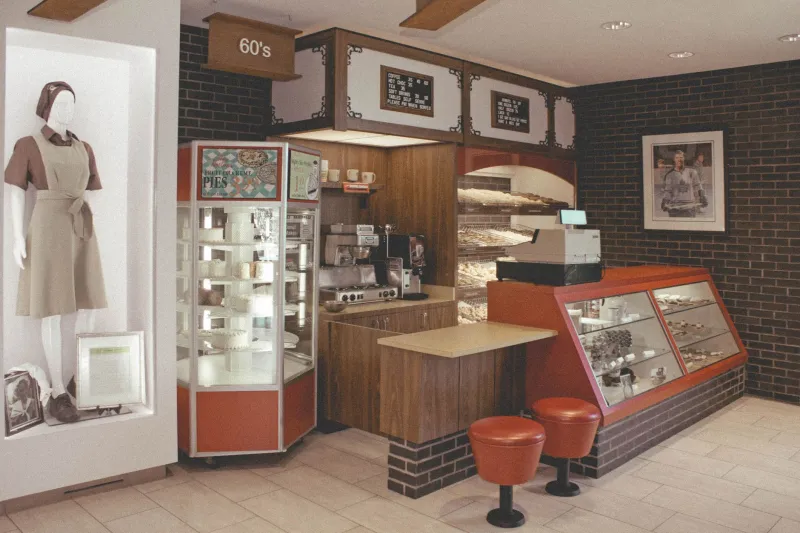
There's a particular kind of American morning that used to exist in almost every town with a stoplight and a zip code. It started at a counter — vinyl stools, laminate top, a coffee mug that got refilled without asking — and it involved people who had absolutely nothing in common sitting close enough to share the sugar. The diner didn't care who you were. It just needed to know how you wanted your eggs.
That morning is rarer now. The diner that anchored it — the one with the hand-lettered specials board and the pie under glass and the owner who knew your name by your third visit — has been closing at a pace that barely makes the news. And in the communities where it's gone, something harder to quantify than a restaurant has quietly vanished with it.
What the Diner Actually Was
The American diner reached its peak cultural saturation somewhere between the 1940s and the 1970s. By some estimates, there were more than 6,000 diners operating across the country at mid-century, clustered especially in the Northeast but present in every region. They were democratic spaces in a way that almost no other commercial establishment managed to be.
The pricing model was the key. A full breakfast — eggs, toast, hash browns, coffee — could be had for under two dollars well into the 1980s. Lunch was a sandwich and soup. Dinner was a blue plate special that fed you without requiring a budget conversation beforehand. This wasn't fast food with its standardized anonymity. It was actual cooking, made in a real kitchen, served by someone who might ask about your mother.
The counter, specifically, was a social technology that deserves more credit than it ever gets. Sitting at a counter puts you shoulder-to-shoulder with strangers in a way that table seating doesn't. You can't retreat into your own bubble quite as easily. The guy on your left might be heading to a construction site. The woman on your right might be a school principal. At the counter, you're both just people who needed breakfast. The architecture of the space enforced a kind of accidental community.
For small towns especially, the diner was civic infrastructure. It was where the school board member ran into the school janitor. Where the morning argument about local politics happened between people who'd known each other for thirty years. Where traveling salesmen got the honest read on a town from the waitress who'd been there since the Carter administration.
The Slow Departure
The diner didn't disappear in a single dramatic wave. It eroded across decades, squeezed from multiple directions at once.
The first pressure came from the fast food chains, which arrived in force during the 1960s and 1970s with something the diner couldn't easily match: consistency, speed, and aggressive pricing made possible by industrial food systems and national supply chains. A family on a budget could feed four kids at McDonald's for what a diner breakfast for two might cost. The diner couldn't compete on that math.
The second pressure was economic geography. As manufacturing declined in small towns and urban neighborhoods across the Rust Belt and rural America, the customer base that filled those stools every morning started to disappear. When the plant closed, the diner didn't last long after. The regulars either left for work elsewhere or stopped having the discretionary income that made a sit-down breakfast feel affordable.
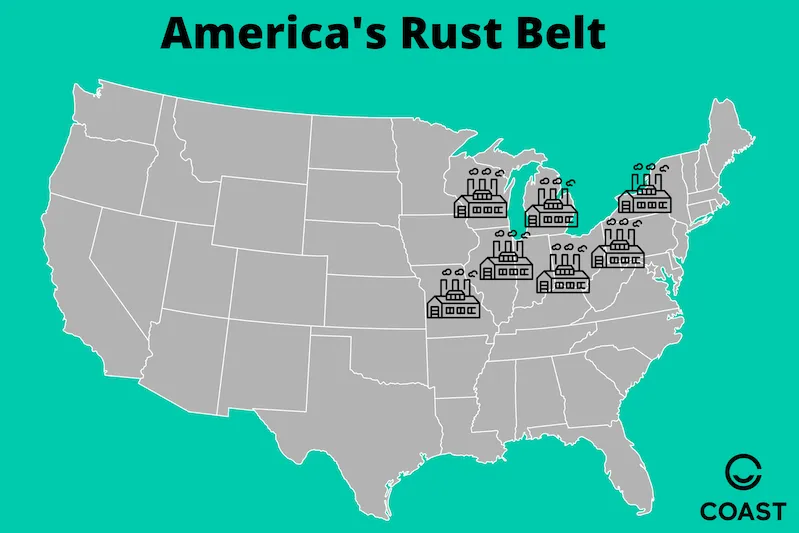 Photo: Rust Belt, via coast-wp.imgix.net
The third pressure was generational. Running a diner is brutally hard work — 5 a.m. starts, thin margins, high labor costs, the physical toll of a kitchen. Many diner owners who'd built their businesses over decades couldn't find the next generation willing to take it on, and couldn't sell at a price that made sense for a buyer to take the risk. So they simply closed.
What Filled the Space
In some neighborhoods, nothing filled the space at all. This is where the concept of the food desert intersects with the diner's disappearance in ways that don't get discussed enough. When the diner closed and no replacement followed, the nearest affordable sit-down meal might be three towns over or accessible only by car. For elderly residents, families without reliable transportation, or low-income workers without flexibility in their schedule, that distance is a real barrier.
In urban areas, the replacement was often a different kind of fragmentation. Delivery apps and ghost kitchens now serve food to people who never share a physical space at all. You can order from fifteen different virtual restaurants operating out of the same industrial kitchen and have it arrive at your door — and never once be in a room with a stranger who ordered something different. The food might even be better. But the experience is entirely private.
The app-driven food economy is optimized for individual preference and convenience. It is not optimized for the kind of accidental human contact that made the diner counter socially valuable. You can curate your meal to an extraordinary degree now. What you can't curate is a community.
The Thing That Can't Be Delivered
There's a reason that diners, when they do survive, still draw loyal crowds — and it's not purely about nostalgia. It's about the experience of being in a space where the terms of engagement are simple and the barriers to entry are low. You sit down, someone brings you coffee, and for twenty minutes you're in the same room as your neighbors living their actual lives.
That's not nothing. In an era of increasing social isolation, declining civic participation, and shrinking third places — the term sociologists use for spaces that aren't home or work — the diner's function looks more important in retrospect than it probably did when it was everywhere.
The timelapse here is about more than food costs and restaurant economics. It's about the slow disappearance of the spaces where Americans of different circumstances were briefly, unremarkably, in the same room together. The diner didn't solve inequality. It just temporarily made it invisible — and in doing so, reminded people that the differences weren't as absolute as they sometimes felt.
The coffee's harder to find now. And refills definitely aren't free.