Your Great-Grandmother Had Same-Day Delivery — She Just Called It Tuesday
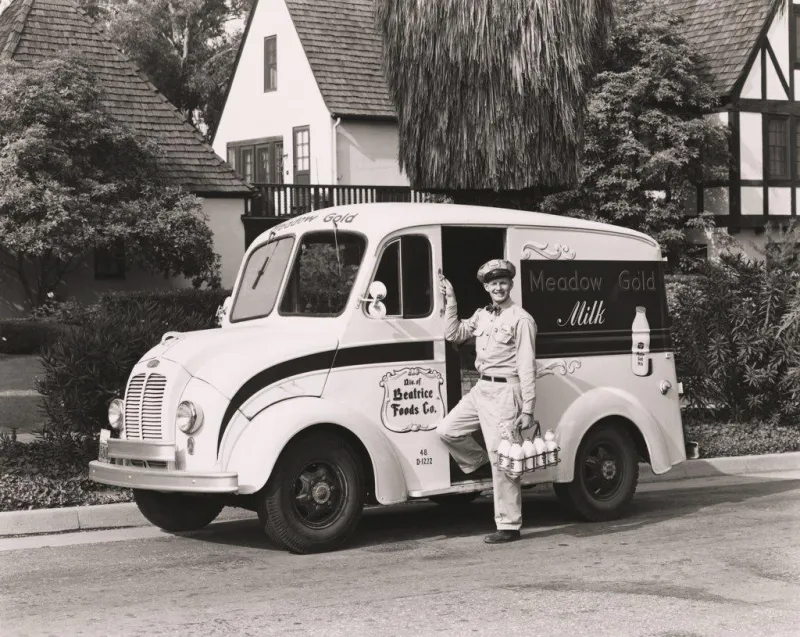
Photo: vintage milkman delivering milk bottles to suburban home 1950s, via cdn.superstock.com
The Man Who Showed Up Before You Were Awake
In mid-century America, the milkman was as reliable as sunrise. He knew which houses took whole milk, which ones needed an extra quart on Fridays, and which families had just had a baby and would need more for a while. He worked a route so familiar he could've done it blindfolded. And he did all of this before most of the neighborhood had finished their first cup of coffee.
Home delivery of milk, bread, eggs, and other essentials wasn't a premium service in 1950s America. It wasn't a subscription tier or a convenience fee. It was just how things worked — a deeply embedded neighborhood system built entirely on routine, relationship, and trust. No app required. No algorithm involved. Just a guy, a truck, and a mental map of exactly what every household on his route needed.
Fast forward seventy years, and America is absolutely marveling at the same concept — repackaged in a smartphone interface and celebrated as one of the defining innovations of our time.
How It Actually Worked
At the peak of home milk delivery in the United States — roughly the late 1940s through the early 1960s — an estimated 30 to 40 percent of all milk consumed in American homes arrived via doorstep delivery. Dairies employed local drivers who built genuine relationships with their customers over years, sometimes decades.
You left a note in the empty bottle if you needed something different that week. The driver adjusted. You went on vacation? He stopped delivery and picked back up when you returned. The whole system operated on the kind of low-friction personalization that today's tech companies spend billions of dollars trying to replicate with machine learning.
And it wasn't just milk. Bread delivery services, produce routes, and even meat delivery were common in many American cities and suburbs. The idea that fresh goods would come to your door on a reliable schedule wasn't novel — it was expected.
The Supermarket Killed It Almost Overnight
The collapse came fast. Through the late 1950s and into the '60s, supermarkets expanded at a pace that reshaped American consumer life almost completely. These massive new stores offered everything under one roof, at prices that home delivery — with its labor costs and individual routing — simply couldn't match.
By 1963, home milk delivery had already dropped to under 30 percent of the market. By 1975, it was in the single digits. The milkman didn't retire gradually. He was made structurally obsolete by a retail model that prioritized scale and price over relationship and convenience.
For roughly fifty years, home delivery of everyday goods essentially vanished from mainstream American life. If you wanted groceries, you drove to the store. That was the deal. Nobody particularly questioned it.
Then the Internet Showed Up and "Invented" Delivery
Amazon launched in 1994 as an online bookstore. By the mid-2000s, the idea of having goods shipped to your home was being treated as genuinely transformative. And in fairness, the scale and speed of what eventually emerged was new — two-day shipping, then same-day, then two-hour grocery windows in major cities.
DoorDash launched in 2013. Instacart followed. Grocery delivery apps multiplied. During the COVID-19 pandemic, the entire category exploded as Americans who had never used delivery services suddenly depended on them. The coverage was breathless. Home delivery is changing everything. Headlines ran regularly about how technology had fundamentally altered the relationship between consumers and their goods.
And here's the thing that should make you pause: your grandmother already had this. She just had it without the $4.99 delivery fee, the 15 percent service charge, and the tip prompt at checkout.
The Differences Are Real — and Revealing
It would be unfair to say the modern version is just the old version with an app. The scale is genuinely different. DoorDash operates in thousands of cities. Amazon delivers to virtually every zip code in the country. The product range is incomparable — your milkman was not bringing you a replacement phone charger at 9 PM.
But the comparison still reveals something important about how Americans think about progress.
The milkman's route was hyper-local, operated by someone who lived in or near the same community, employed by a regional dairy, and priced as a basic service. Today's delivery ecosystem is dominated by massive platforms that take significant cuts from the vendors, pay drivers as independent contractors without benefits, and use surge pricing during high-demand periods. The convenience is real. So is the cost structure that makes it work — and who it actually benefits.
A recent analysis found that grocery delivery through major apps typically costs 15 to 25 percent more than buying the same items in-store, once you account for markups, fees, and tips. Your great-grandmother's milkman charged market rate for the milk and a modest delivery fee. The math was simpler because the incentive structure was simpler.
Nostalgia Isn't the Point — But the Comparison Is
Nobody is seriously suggesting America should go back to glass bottles on the porch and handwritten notes about extra cream. The modern delivery ecosystem has genuine advantages that would've seemed like science fiction in 1955.
But there's something worth sitting with in the realization that one of the most celebrated technological developments of the 21st century is, at its core, a rebuilt version of something that existed before most current tech executives were born — and that the rebuild, for all its sophistication, isn't obviously better for everyone involved.
Progress tends to move in spirals more than straight lines. Sometimes the future arrives and it looks remarkably like a Tuesday morning in 1952, with a truck pulling up before dawn and a driver who knew exactly what you needed.