The Marching Band Used to Be Everybody's: What Happened When Music Stopped Being Free
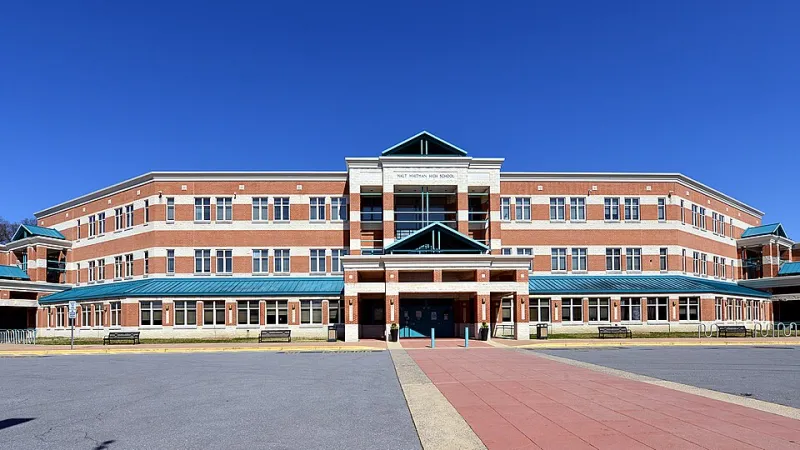
Photo: G. Edward Johnson, CC BY 4.0, via Wikimedia Commons
The Marching Band Used to Be Everybody's: What Happened When Music Stopped Being Free
Every town in America used to have a parade. And every parade had a marching band.
Not a professional ensemble. Not a curated performance group with selective auditions and per-family fees. Just the kids from the public high school, in matching uniforms that had been re-hemmed so many times the stitching showed three different colors of thread, playing something recognizable enough to make the crowd clap along. The clarinet section was off by a half-beat. The tuba player in the back row was visibly sweating. None of it mattered. They were out there, all of them, and it cost their parents exactly nothing to put them there.
That version of American music education — universal, free, woven into the school day like math and English — is disappearing. What's replacing it is a patchwork of booster drives, instrument rental fees, and program cuts that have turned the school band into something closer to a club sport: available in theory, accessible in practice only to families with the time and money to make it work.
The Era When Every Kid Got a Shot
At its peak, public school music education in the United States was genuinely remarkable in its reach. By the 1960s and 70s, the majority of American public schools offered some form of instrumental music instruction beginning in fourth or fifth grade. School districts purchased instruments. Teachers were certified specialists. Participation rates were high enough that the school band wasn't a niche activity — it was a mainstream one.
The model was built on a simple idea: exposure first, talent later. You didn't need to demonstrate musical ability to join. You showed up, got assigned a clarinet or a snare drum, and spent a semester figuring out whether it clicked. Some kids discovered a genuine passion. Most didn't — but they still learned to read music, to work within an ensemble, to practice something difficult and eventually get better at it. That process had value regardless of whether anyone went on to play professionally.
And the cost to families? Essentially zero. The instruments were school property. The instruction happened during the school day. The uniforms were handed down through decades of graduating classes. The whole system was funded by the same tax base that paid for science labs and gym equipment, because the people who designed it understood that music education wasn't a frill — it was part of what school was for.
When the Budget Axe Found the Band Room
The defunding of arts education in American public schools didn't happen all at once. It was a slow erosion, driven by a combination of fiscal pressure, shifting political priorities, and a gradual cultural shift in how we defined "essential" learning.
The No Child Left Behind era accelerated things considerably. When schools began to be evaluated — and funded — based primarily on standardized test performance in math and reading, administrators faced a stark choice: protect the subjects that showed up on the tests, or protect the ones that didn't. Music, art, and drama were rarely on the test. They were rarely protected.
By the 2000s, the pattern was well established. Urban districts, already stretched thin, cut music programs first. Rural districts followed when state funding formulas tightened. Suburban schools often kept their programs, but shifted costs onto families — instrument rentals, participation fees, uniform assessments — in ways that created quiet barriers for lower-income students who couldn't say out loud that they couldn't afford it.
The marching band survived in many places. But it survived through booster clubs, fundraising pasta dinners, and parents working the concession stand on Friday nights to keep the drum line stocked with heads. The program was technically free. The labor required to sustain it was not.
What the Research Has Always Said
Here's the frustrating part: while school districts were cutting music programs to save money, researchers were publishing study after study demonstrating that music education produced measurable academic and developmental benefits.
Children who participate in music instruction show stronger performance in reading and language processing. The act of learning to read musical notation develops the same neural pathways used in mathematical reasoning. Ensemble playing — the experience of listening, adjusting, and synchronizing with other musicians in real time — builds social cognition and collaborative skills that show up in classroom behavior and adult workplaces.
None of this is new information. The research has been consistent for decades. And yet the programs kept getting cut, because the benefits were hard to quantify on a standardized test and the line item was easy to find on a budget spreadsheet.
What got lost in that calculation wasn't just the music. It was the specific experience of being a ten-year-old who picks up a trumpet for the first time, sounds terrible for three months, and then one afternoon plays a recognizable melody and feels — maybe for the first time — the particular satisfaction of having built something through persistence.
That experience doesn't have a test score. It has a person.
The Zip Code Problem
Walk into a well-funded suburban high school today and you'll often find a music program that looks impressive: a modern band room, quality instruments, a full marching band that performs at competitions. Walk into an underfunded urban school in the same state, and you might find a single overworked general music teacher covering five grade levels with a cart of instruments that haven't been serviced in years — if you find a music program at all.
The gap isn't about what communities value. Survey after survey shows that parents across income levels believe music education is important. The gap is about what communities can afford to fund, and which communities have been systematically defunded for long enough that the infrastructure no longer exists to rebuild easily.
A marching band requires instruments, a director, time in the schedule, a storage space, and uniforms. You can't bootstrap that from a bake sale.
What the Parade Is Missing
The marching band was never really about music. Or rather, it was never only about music. It was about visibility — the experience of being a public school kid who got to be part of something the whole town watched. It was about belonging to an ensemble large enough that your individual imperfections disappeared into something collectively impressive. It was about the particular democracy of a school activity where the kid who struggled in English class could be first chair.
When we stopped funding it universally, we didn't just lose a program. We lost a version of public education that said, without ambiguity: your creativity matters. Your participation matters. This is yours, regardless of what your parents earn.
The parade still happens in some towns. The band still plays. But in too many places, the kids marching are the ones whose families could afford to keep them there — and the ones who couldn't are watching from the sidewalk, wondering why nobody saved them a uniform.